Designing for Presence: Attunement as the Consonant Harmony Between Nervous Systems
When logic fades, rhythm remains. When language fails, tone still speaks. Across care, leadership, education, and everyday life, presence—not technique—is often the doorway to safety.
Attunement is the consonant harmony between nervous systems.
When we find shared tempo, key, and dynamics, safety becomes audible.
In a cataclysmic world saturated with threat, misinformation, and rupture, safety is no longer ambient—it must be actively co-created. Attunement is how safety, connection, humanity, and trust are built between nervous systems.
Safety precedes strategy.
Connection sustains care.
Humanity restores dignity.
Trust enables change.
Before the System: A Human Doorway Into Attunement
Most of us don’t have language for attunement—but we recognize it the moment it happens.
It’s the feeling of being truly seen without having to explain yourself.
The way your breath softens when someone speaks to you gently.
The quiet relief when another person slows down to match your pace.
The moment a room feels safer because someone chose to listen before they led.
This is attunement in everyday life.
Attunement is what happens when another human meets you where you are—not where they need you to be. It’s the difference between being talked at and being accompanied; between being managed and being held in your humanity.
In a world that rushes us, interrupts us, and asks us to perform resilience, attunement is a small, radical act of care. It tells your nervous system: you are not alone here; you don’t have to armor up.
Attunement is the consonant harmony between nervous systems.
When someone finds your tempo, safety becomes audible. When they join your rhythm, your body remembers how to soften.
You don’t need training to practice this. You’ve felt it when a friend sat with you in silence. When a nurse adjusted their tone. When a stranger’s presence steadied you in a hard moment. These moments of consonance restore something essential: the sense that we are allowed to be human together.
In cataclysmic times, attunement becomes a form of everyday resistance. It’s how we protect dignity in small moments. It’s how we rebuild trust one interaction at a time.
The Systems Problem (Not a People Problem)
We ask people to move fast, document more, manage risk, and remain compassionate. Even when clinicians, leaders, and educators understand how the brain processes emotion, environments often reward throughput over presence. Attuned communication becomes something to “add on,” rather than something structurally supported.
Designing for presence is less about training soloists and more about arranging an ensemble. When pace, environment, leadership cues, and workflow are out of sync, even the most skilled humans struggle to stay in rhythm. When the system holds a steady tempo, attunement becomes easier to sustain.
The Training Gap: Fear of Reflection
Across motivational interviewing trainings, CPI classes, and palliative care conferences, I’ve noticed significant resistance to the concept of reflection—as if mirroring words, tone, affect, or presence is inherently counterintuitive or difficult, rather than a learnable, supportive skill. We teach what to do, but rarely how to meet the chaos of dysregulated nervous systems.
Reflection isn’t mimicry. It’s entrainment—listening for tempo, key, and dynamic so another nervous system can safely begin to play again.
A Clinical Moment That Made It Audible
Recently, an MD noted how mirroring a withdrawn individual’s vocal tone, volume, timbre, and posture helped me meet her where she was and co-create a sense of safety the environment itself hadn’t yet been able to offer. In that moment, safety emerged not because I led—but because I listened for her song and joined her in it.
When our nervous systems are wired by chronic stress to withdraw, flee, or resist, the mind and body struggle to integrate new information. When cognition is compromised, rhythm, tone, and presence remain reliable thresholds to regulation and genuine connection.
Reframing “Musical Skills” as Relational Skills
Attunement to tone, rhythm, pacing, timbre, and embodied presence are foundational musical competencies—and they are also nervous-system skills. These aren’t artistic flourishes. They are relational stepping stones to safety, trust, and engagement across any human system.
Presence is the downbeat. Without it, everything else falls out of time and out of tune.
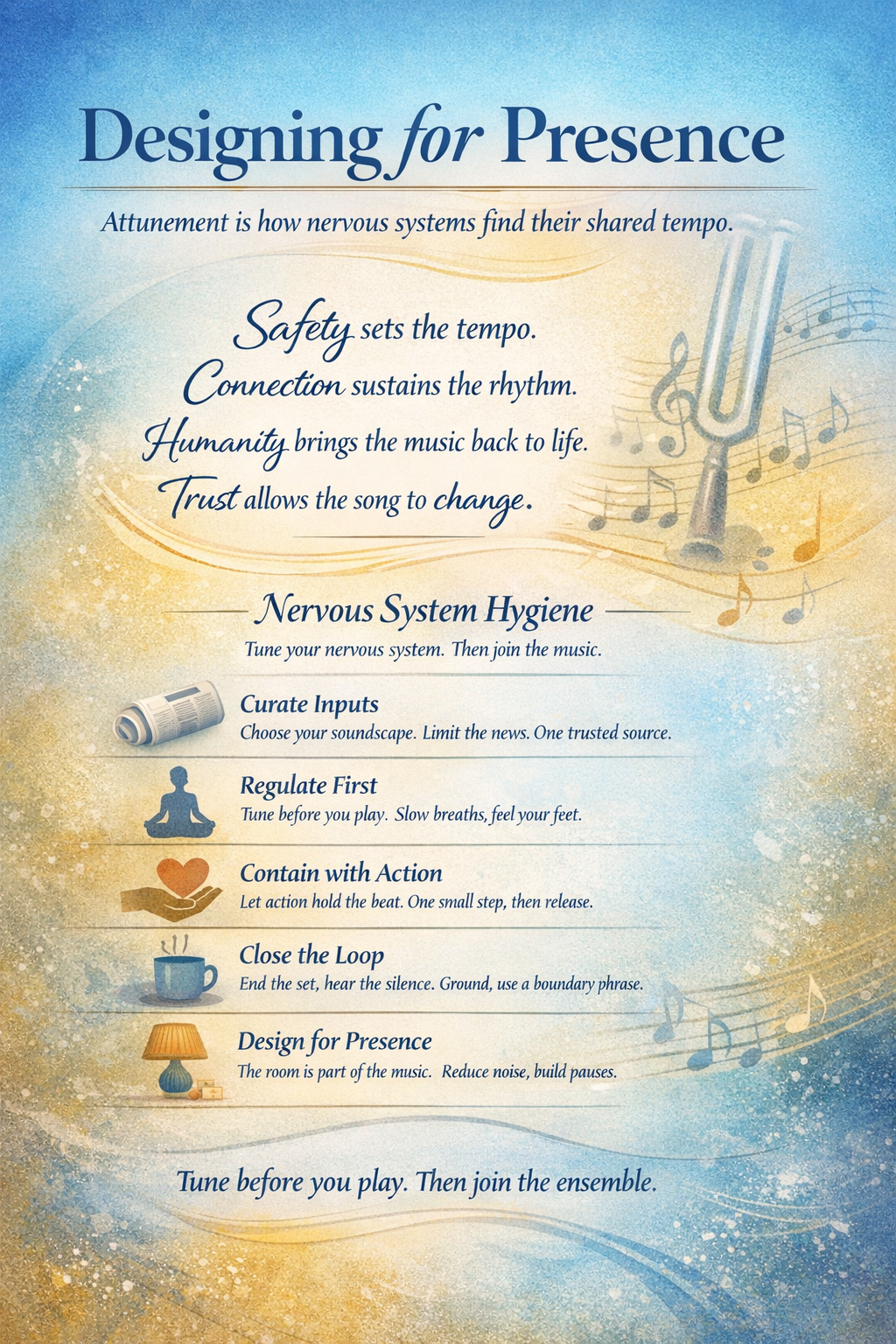
🧼 Nervous System Hygiene
Keeping Your Instrument in Tune (for Highly Attuned Humans)
If attunement is your gift, hygiene is how you protect it. Presence without boundaries becomes depletion—especially in a media environment engineered to dysregulate.
1) Curate Inputs
Choose your soundscape.
Time-box the news. Pick one trusted source. No heavy content before bed.
2) Regulate Before You Relate
Tune your instrument before joining the ensemble.
Three slow exhales. Feel your feet or press palms together for 10 seconds.
3) Contain Empathy with Rest
Every rhythm needs moments of silence.
Take one small action—then pause.
4) Close the Loop
End the set. Let your body hear the silence.
Grounding ritual + a boundary phrase: “I can care without carrying this alone.”
5) Design Your Environment for Presence
The room is part of the music.
Reduce noise. Protect transitions. Build pauses. Choose cues of safety.
Closing
Designing for presence also means designing for protection. Attunement is relationally essential—but without nervous system hygiene, it’s unsustainable.
Tune your nervous system. Then join the music. 🎶
